
Comeback is REAL

In case my posts belong to the funny and interesting kind and you prefer the boring academic stuff

Funny Jo shall TRY to do up a serious discussion on today’s topic

*derp*

In today’s world, where digital marketing seems to be the niche across organisations

It seems highly effective and all.. but what exactly is the focus?

‘Digital’ or ‘Marketing’?

Marketers will soon realize that the ‘Digital’ media is just a new phase of transition, and ‘Traditional’ media will swing back even harder in this new age

‘Digital’ is simply a new playground for marketers to connect with their consumers.

So what is Digital Marketing then?

Its…

Nothing actually.

wut

It is just traditional marketing, done digitally.

Many might have mistaken that digital marketing breeds new ideas and strategies to attract but truth is.. its still the same concept.

Marketers are still required to analyse the market and react according to consumer behaviors. Just that these marketing strategies are now executed on digital platforms that we people now excessively engaged in

ERRRRRRRR

A good example Mark Ritson mentioned in his speech was that businesses tend to mindlessly seek marketing assistance on digital media platforms

assuming that it would bring greater success

His studies proved companies that invested so much effort and money on building a marketing team just to tackle the social media, expecting exceptional returns are just being illogical

Businesses overvalue the power of influence social media has over consumers towards their products and services, neglecting other forms of marketing

Digital marketing isn’t just about the Internet.

Although communication has gone online, and newspapers can be read from phones and laptops, the majority influence of consumers still come from traditional forms of marketing

Newspapers, radios, television

You really shouldn’t be surprised.

It’s true.

The time spent on television is significantly more than social media platforms based on Mark Ritson’s speech on Mumbrella in 2016

Even the assumption of the millennial spending more time on digital devices is false

I mean.. that’s what he said la so

I personally think it’s still a good thought to consider social media as a good channel to connect people to businesses

It’s just that social media marketing teams engaged to do that for companies lack that…. feel

aiyo feeling feeling

They just fail to convince consumers that they are passionate about promoting their products

Companies rely so much on Facebook analytics, letting them do all the work

Hence producing sub-par results

These social media platforms offer promoting services, only to give companies inaccurate view counts based on the infamous “3 seconds view” and ineffectual feedbacks

Are they really helping the businesses connect, or is it just for profitability purposes?

HMMMM

I suggest putting more effort designing your marketing strategies YOURSELF, because those numbers are simply unreliable

Sometimes you need a little ‘Traditional’

Don’t you think?

Thanks for reading!

ARE YOU EVEN LEGAL?

Looking back at my first post, where I explained about how we nasty humans today are amusingly addicted to our mobile phones..

Have you ever felt so annoyed when you know it’s already bad enough not being able to resist looking through your phone whenever a notification comes in and..

walao eh

Worse

only to see a spam

confirm sot

So today we’ll (technically it’s just me) delve into the truth behind the lies..

ARE SPAMS EVEN LEGAL?

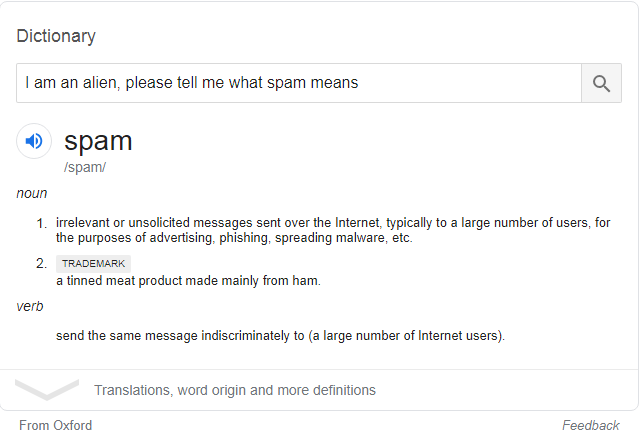
Before i start on anything, just in case you’re an alien and the word “spam” seems foreign to you


Or maybe

I should show you


the art of spam

There you go

Anyway

Controversially, to businesses, spams that we receive are forms of marketing

These spams that companies send out are means of advertising, and they can be sent not only through emails, they can be from online posters, texts or calls

So are these spams legal?

Actually these spams can be legal, and the SPAM act allows recipients to opt-out whenever they feel like

the SPAM act also requires businesses to remind recipients regularly that it is possible to opt-out from receiving their messages and businesses have to deal with strict penalties for any violation

Now that we know spams can actually be legal, are they then, useful for marketers?

In all honesty, if they are appropriate and relevant to directed recipients, spams will not be called spams in the first place

duh.

In my humble opinion, spams are just irrelevant if not unethical

Unethical?

Imagine a candy company heavily promoting their new product to the global market, which unfortunately, includes the diabetic patients and customers who love candies but already have damaged teeth

Should these advertisements be all over the internet without properly narrowing down the scope of their audience?

How much do they actually know about their recipients before sending messages of their products?

hmmm..

Even for recipients who agreed on receiving updates on their products and such, do companies explicitly ask if they are diabetic or have bad teeth?

Would it be ethical to ask such sensitive questions?

Let’s just say knowing that some customers already have bad teeth but still checks both the box that says “send me updates on new products” and “I have bad teeth” on their membership form

Should companies still send updates?

As for the marketers…

Wouldn’t it be manipulation rather than persuasion?

If that’s the case, aren’t marketers using personal information inappropriately?

Although these spams are just extremely low cost alternatives for marketing, but it may bring more harm than good

Spamming their advertisements or messages inappropriately to the wrong crowd can affect their reputation and turn consumers away from their products

AND

It is already a growing concern for people across the world, with many left worried about their personal information being misused

How will spams be of any benefit to these businesses now and the future?

What do you think of these spams?

Thanks for reading! Feel free to leave a comment
Kind comments please

If not

ok kidding bye

The “Hit” man

Well before the digital marketing workshop starts this week, as usual I started watching lecture videos online and one segment in particular, got me extremely intrigued

VIRAL MARKETING

How do people actually do that?

Truth be told… I USED TO have this dream back then when i was younger

To upload singing videos on YouTube, hoping it’ll go ALL viral on me someday

Then yknow, hopefully get scouted by some legend and

POOF

ah….. lai liao lor.

I mean…

you can’t blame me for dreaming right

My parents taught me I must dare to dream

UH HUH

…but they teach halfway la didn’t tell me I must dare to act

Ok whatever it is, apparently that was the case for me

so i thought maybe I should read up more on viral marketing just for the fun of it


Ok maybe not just for fun, I lied I still have that dream

Anyway as Kevin Alloca, YouTube’s ‘Trend Manager’, explains on Ted Talk, having your videos to go viral are not works of spells and sorceries

To make your videos stand out among the 48 hours worth of videos uploaded to YouTube every minute, and out of that only a terrifically small percentage of videos achieved more than 1 million views

There are three important things you’ll have to keep in mind while designing any viral video

  • Taste makers
  • Creative participation of community
  • Unexpectedness

Taste makers are those with substantial influential power, that often bring new and interesting things to a larger audience

It could be celebrities, influencers, or some dude who does reaction videos

but if you could somehow grab a hold of their attention and get them to take a point of view, allowing them to share it to a larger audience

VOILA!

You could be the next BIG THING

Next up, having the space for the internet community to express their creative participation towards your videos can help with getting it viral

Remember the Nyan cat? Even this ridiculous 10 hours long video has amounted to 90 million views

…can you believe what people are watching nowadays

Main point is, creating such a space for the community to view and be a part of, changes the way people react

They don’t just enjoy, now they participate

The original video was then modified by people across the globe just for the fun of it, coming up with variations of the cat.

Link is below for your entertainment

https://www.youtube.com/watch?v=YfYYUsA9VpE

Enjoy

OH this video is at 16 million views by the way

Last point, which is the hardest to achieve while devising the ultimate viral video

amid the world where 2 days worth of videos are uploaded every minute, how can one make a video so unique and unexpected that it will stand out?

Well…

You”ll probably have to come up with a surprising idea yourself

Maybe this?

https://www.inc.com/christina-desmarais/25-ways-to-be-more-creative.html

Whatever works.

With that being said, taste makers, creative participation of the community and complete unexpectedness constitutes to the new kind of media culture that surrounds us

Where ANYONE has access and THEY are the ones who decides the popularity

So before i start on my YouTube journey…

I better have some tricks (or cats) up my sleeve

oh and please get me some taste makers you’re part of it now

Thanks for reading!

Search Engine Marketing – Friend or Foe?

“Shoot, i need to get a suit for my friend’s wedding next week. Where should i buy from? Let me google that.”

Find that familiar?

We use Google so often that it becomes a part of our daily activities, be it for studies, work, or just out of our plain curiosity. Convenient and powerful, Google is the most powerful search engine in the world. This tech giant is constantly evolving and looking to improve the search engine algorithm to provide best results to the end-user.

Since it is customary, how much do you actually understand Google then?

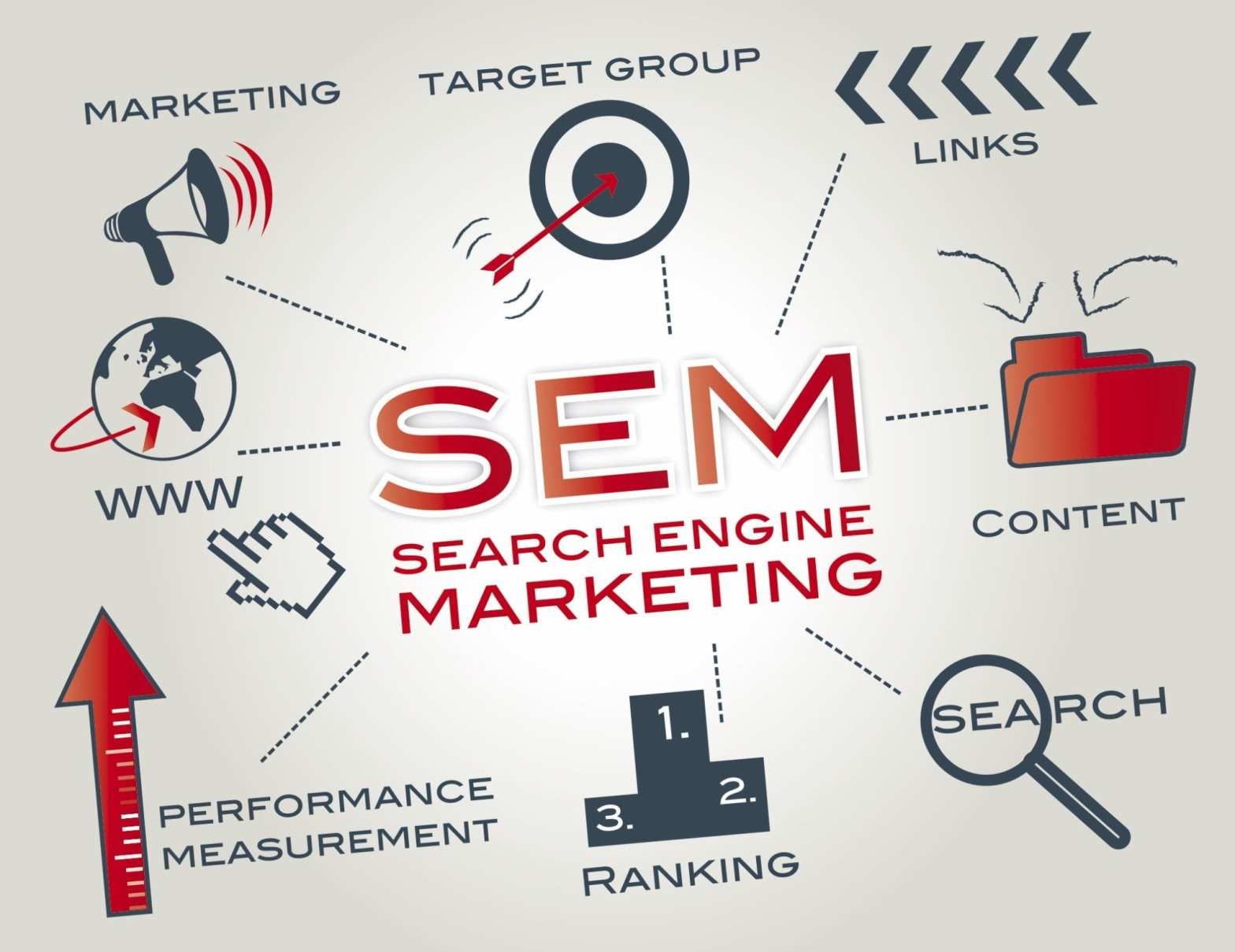
It is a form of Search Engine Marketing that involves Search Engine Optimization (Organic Listings) and Paid Search Marketing (Sponsored Listings).

So if consumers rely on these listings to make their decisions on whichever, how does Google determine who should stay on top of the list and so forth?

There are some criteria that google looks into before they rank just about anything among the listings.

…Probably about 200 of them.

Lucky for you, Google made it easy for you to understand what Google needs.

These are the main factors you should consider before even thinking of coming off first on the listings. Paid, or not.

  • Website Architecture
  • Domain Security
  • Inbound Links
  • Topic Authority
  • Keyword Intent
  • Content Structure
  • Meta Tags
  • Page Speed

If you feel like a curious cat, please google them for more information.

…uh?

So after understanding Google a tad more than before…

SO HOW DO I GO ABOUT FINDING MY SUIT?

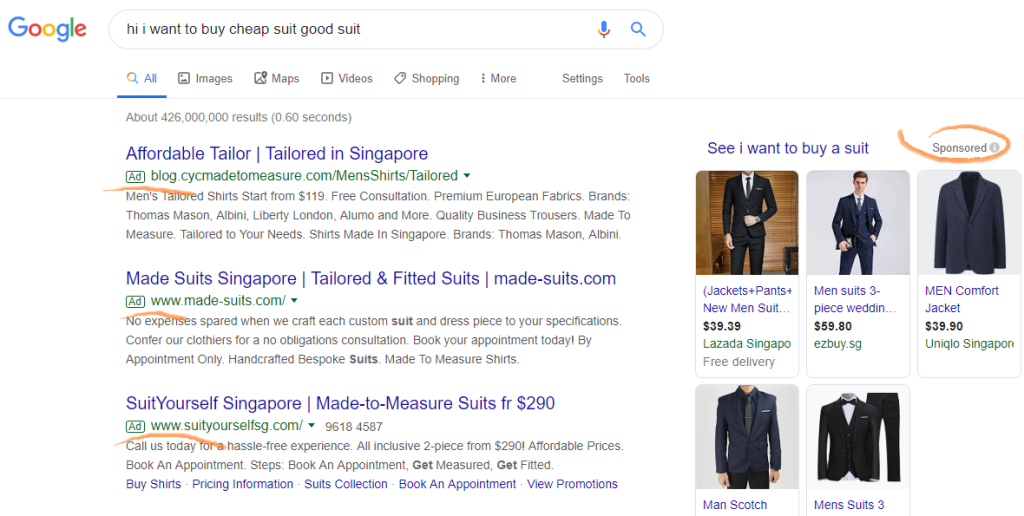
Apparently after a very serious search on Google, this is what i found.

As you can see what the first page of Google’s search engine results pages (SERPs) offered, most of them came from Paid Search Marketing.

So the question today is…

Are these results genuinely the cheapest and best suits out there?

I don’t think so.

WHAT IF there are better options out there?

There could be a better suit store right around the corner offering a much more affordable price for you. Just because they fail to fulfill the criteria as effectively as the rest, it does not mean that their product is worse off.

WHAT IF they are not tech savvy, but is still considered a reputable store? Good customer base and retention, affordable price, good location. Is there really a need for building a right-on website or even resort to paid advertisements?

What I am trying to say is that not all results from the search engine you abuse could be the best. What’s worse, it could even lead you to the wrong set of products. Marketers can include extremely common keywords can be misinterpreted.

So before you jump on the conclusion of Google showing the best results… maybe you could use a little “old school”. Try asking around, word of mouth works magic.

Or simply take a walk down the streets. Who knows?

You’d be surprised.

Thanks for reading!! (Oh and wish me luck on the suit)

Big Data & IoT…For better or worse?

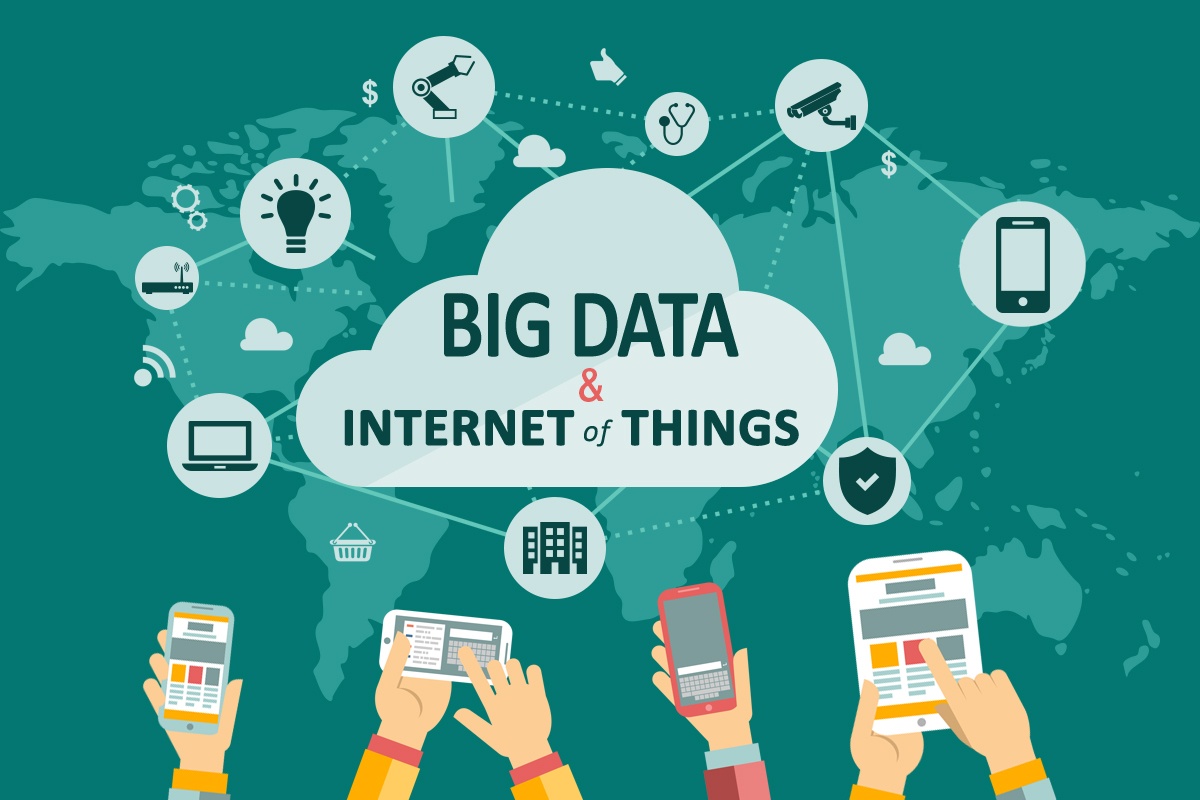
These days, we mortals depend heavily on the dimension of Big Data to lead our daily activities regardless of the time and place. This also means leaving digital footprints whenever, wherever.

“From dawn of civilization until 2003, humans created 5 exabytes of data.”

Eric Schmidt – Ex CEO Google 2010

This is almost equivalent to 5,000,000,000,000 megabytes and you guessed it, we are now creating that much every 2 days.

So is this thread of footprints traceable? Is it dangerous?

It could be.

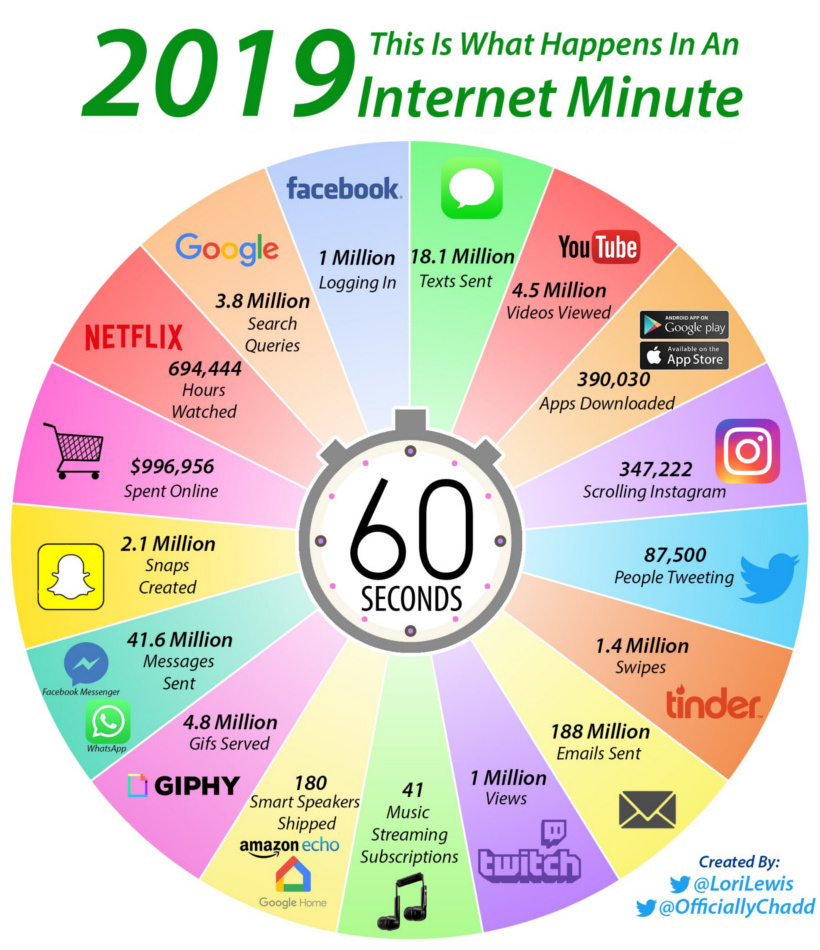
Have you ever wondered how much data is being transmitted every minute on the Internet?

This can be a whole load of exposed information.

Having such a big amount of data exposed online can be posed as a threat due to the lack of privacy. It is natural for consumers to be skeptical about the use of big data as they risk the possibility of their information landing on the wrong hands.

Even if consumers opt to make their information “private”, do they really have the information solely to themselves, or who exactly can have, or rather who else has access to it?

Despite the chances of getting your nude photo leaked, it is still, a sea of data to extract from, much of a hassle than just opening your closet and picking a shirt from it.

I meant a guy’s closet.

Through the forms of text, audio, video, social media and predictive analytics, marketers can tailor their marketing mix specifically for individuals, increasing relevance for their consumers.

Is it then, all for the good?

Probably not.

These automation lacks the emotional understanding and other aspects that technology fail to provide, to accurately decide what consumers really want. Like promoting burgers to an obese, or even promoting a sugar free product to a diabetic patient. Do they really want YOU to know? Do you then, really understand what they want?

Now, the Internet of Things (IoT)

So you’ve seen increasingly smart cars, smart TVs, smart watches and many other gadgets, what about smart people?

Well…

Of course we do.

While the IoT(Internet of Things) involves a presence of a variety of devices interacting and cooperating with each other to reach common goals, what do they actually do?

They make your life easier! From the collection of your data through antennas, sensors or micro-controllers, they collate and transfer data through the IoT gateway, then analyze and act accordingly on different platforms. Be it the user interface on your phone, your business applications, or just stored in the back end systems in case you need it some day.

So the question is, does it really improve the living of people?

Yes it does undoubtedly, but there are several drawbacks questioning the direction of such.

It makes people lazy, having the over reliance on these devices.

Need to switch off the TV?

“Hey Google!”

Need some music?

“Hey Google!”

Need to plan your day?

“Hey Google!”

Need a girlfriend?

Well, you get it.

It does make people impatient too, ultimately affecting the values we should cultivate to begin with.

What about health concerns?

An article from Vest Tech explains that not only smartphones and laptops emit radiation. Tablets, earphones, and wearables are included in the list.

They may be small and generally inconspicuous, but these devices work in tandem with your smartphone or laptop, and requires connectivity from your wireless main devices. This means it constantly seeks radio or WiFi signals, consistently emitting radiation. The most worrying thing here is that smartwatches and fitness trackers are meant to be worn on your body, typically on your wrist or around your neck, which means you are always exposed to it.

So if your parents constantly warn you to put away your phone before you sleep…

Let alone wearing them wherever you go.

After optimizing the smaller interfaces for smart watches, consumers now have more power through these devices. Other than faster information retrieval, price comparisons, product reviews, they too, now have the power to pay with these devices.

What about the complications on it?

These devices contains lots of your data, including sensitive information that you may not be very keen to share. Personal information, access to your credit card, access to all your social media accounts. In turn, it makes you an immensely paranoid soul. Congratulations, it now offers probably more value than your wallet.

So be careful the next time you place both your watch and wallet in your gym bag when you head to the shower room.

Just kidding.

Of course, not everyone agrees on following the trend of utilizing such devices, mostly the older age group. These group of people tend to see no “real” benefit as to the ease of convenience such devices can bring. The rapid changes can be too overwhelming for them, hence being left behind over time. This is a concern as it disrupts the cohesion of society.

So do you stand with/against?

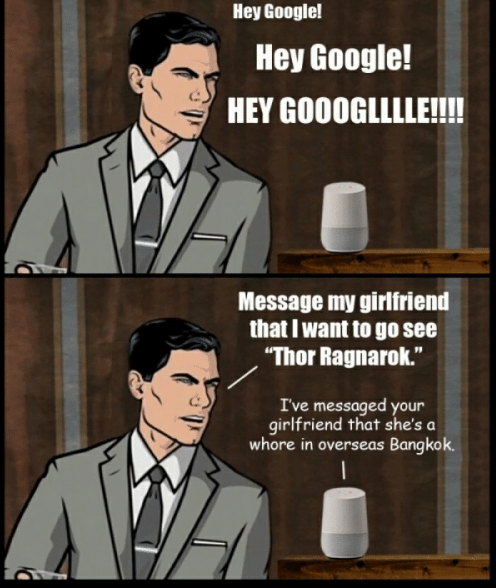
Although it’s gonna be hard to kick the habit of shouting “Hey Google!” wherever you go, at least you now have the power to know a day before Thor comes down for the Avengers’ meeting.

Thanks for reading!

Mobile Marketing

“We live in a world where losing your phone is more dramatic than losing your virginity. “

— Anonymous obviously

If you were to receive a notification right now, will you be able to resist the temptation of checking your phone? How many times have you heard your imaginary ringtone ringing at the back of your head? These days your mobile phone addiction is probably worse than your gambling addiction.

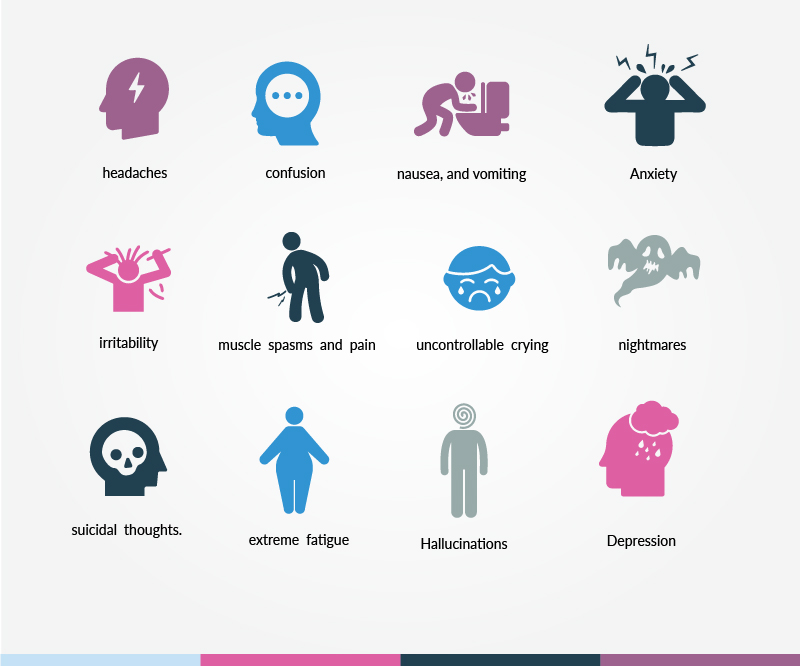
*WARNING* Mobile phone withdrawal symptoms may include:

You cannot deny the fact that mobile phones have taken over all of us these days. As technology advances, we now have easy access to almost everything you need anytime, anywhere

well…yeap

According to Yellow Social Media Report (2018), more Australians own a smartphone (87%) than a laptop (76%)

After countless nights innovators work tirelessly to improve technology, so do we finally get technology to what we want them to, or are we instead, turning into slaves of technology?

Yeap.


So as marketers…

How should you do it?

So duh, all basic marketing tools like ads, websites, apps, secured payment options should already be made mobile compatible and easily accessible on-the-go. So more likely, you have a chance to appeal to us (the very much on-the-go kinda humans)

Hungry? …NO PROBLEM!!
Order MacDonalds looo

Wardrobe malfunction? …NO PROBLEM!!
EzBuy looo

Running late? …NO PROBLEM!!
Book Grab looo

No girlfriend?

NOT MY PROBLEM!!

Well yes without these basic features, marketers won’t even stand a chance in the highly competitive and globalised business environment today.

“So what else about mobile marketing makes it seem just so interesting and competitive?”

-Anonymous obviously (Power of the Internet)

Can you count the number of times you’ve logged into your social media accounts just today?

Don’t act

CONFIRM LIE

All of your Instagram, Facebook, Twitter and Snapchat accounts have so much value than you’ll ever know. Yes, these platforms are so powerful they know your personal information and preferences more than yourself.

How you may ask?

So these social media marketers incorporated a great way to market their target audience efficiently, with the 4 I’s of the mobile social media;

Individualize activities to take account of their user preferences and interests

Involve user through engaging conversations

Integrate appropriate activities into users’ life to avoid being an annoyance

Initiate the creation of user-generated content

So next time if you ever wonder…

“How does Instagram know that i love chicken wings?”

you guessed it right.

Thanks for reading! Please feel free to leave kind comments!


Design a site like this with WordPress.com
Get started